🕺 0.5.0 — Keypoint detection
The Pose-smoke tier has run and was accepted 2026-08-25 at roadmap 125. This section records what the run measured, and states plainly what it was and was not accepted on: the acceptance criterion is R14's mechanism claim — that RLE's learned residual density earns real accuracy over a non-flow control — not a pose figure, and not R1 Table 9's mAP=63.0, which no run in this project has ever targeted.
What was reproduced
RLE (R14) composed onto the same dual head, NMS-free deploy path and training loop the other three tasks share, plus COCO's own OKS evaluation protocol (R12).
| mechanism | reference | implementation |
|---|---|---|
| keypoint targets, left/right flip pairing | R12 (17-point schema), A64 | data/targets.py — Targets.keypoints/keypoint_vis; HorizontalFlip(keypoint_flip_pairs=...) swaps identity rather than mirroring coordinates alone, dataset-supplied rather than hardcoded |
| point head stem, decode | R14, WP-122 | models/heads/detect.py — a third stem per branch, raw (x, y) offset plus raw per-axis sigma; decode_keypoints composes with the anchor-centre/stride convention decode_ltrb already uses |
| RLE loss | R14 Eq. 8, Eq. 12, sec. 3.2–3.3, A65, A66, A71, A72 | losses/rle_loss.py — a hand-written 6-layer RealNVP flow over the per-axis-normalized residual, summed with a fixed unit Laplace NLL; the only trainable-weight loss in the project |
| Laplace-NLL control | R14 Table 7, WP-135 | losses/keypoint_nll_loss.py — the same residual likelihood with the flow term removed, everything else held; a keypoint_loss switch, default rle |
| OKS evaluation | R12, A67 | eval/coco_eval.py::evaluate_keypoints — faster_coco_eval.COCOeval_faster(iouType="keypoints", ...), R12's 17-value sigma table when num_keypoints == 17, A67's uniform sigma otherwise; ground truth's own area/iscrowd/num_keypoints/bbox used directly rather than reconstructed |
| epoch-level pose signal | WP-137 | val/oks_mAP, accumulated per validation step and scored once per epoch, beside val/mAP rather than instead of it |
| standalone report | WP-134 | lucid-eval dispatches on the checkpoint's own task, scoring both decode paths from one forward |
No published or gated parameter/FLOP reference exists for this task family: R14 states a loss and an evaluation protocol, never an architecture, so unlike detection ([R1 Table 7]) and segmentation ([R1 Table S9]) there is nothing to hold the point stem's cost against beyond this project's own measurement — see model_cards/keypoints.md.
The fast wiring gate runs before any COCO launch: scripts/overfit_micro.py --task keypoints reaches train OKS AP 0.3357 over 548 instances against a 0.30 floor, on R21's synthetic SymbolShape schema (goldens/gpu/overfit_micro_kp.json) — not COCO's 17-point schema, since the gate's fixture family is geometric shapes throughout, and A67 records the sigma substitution that makes an OKS figure meaningful on it at all.
The Pose-smoke run
Run v11 — 0.5.0.dev1, COCO person_keypoints_{train,val}2017, task: keypoints, num_keypoints: 17, keypoint_loss: rle (default), n scale, batch 128, lr 0.02, MuSGD, warmup 3 epochs then linear decay to lr0 * 0.01, close-mosaic for the final 10, EMA (decay 0.9999, tau 2000), gradient clip 10.0, keypoint_gain = 1.0 (A68), bf16-mixed, seed 0, deterministic: true, 50 epochs = 46,250 steps on one unrecorded Colab GPU, 7h06m wall clock — about 8m30s an epoch, derived from artifact timestamps rather than logged, matching the other COCO tiers' own unrecorded-hardware pattern.
The Laplace-NLL control (version_14, read together with this run in Acceptance below) trained the next day under an identical config but for keypoint_loss: laplace_nll, at 0.5.0.dev2; two attempts to launch it (version_12, version_13) wrote only a TensorBoard writer's opening record and nothing else — no config, no step — before exiting, 11 seconds apart. Their cause is not in what synced to Drive; the third attempt (version_14) ran to completion without incident.
Evaluated by lucid-eval on COCO val2017, all 5000 images, person_keypoints_val2017 ground truth:
| path | box mAP50-95 | box mAP50 | box mAP75 | OKS AP | OKS AP50 | OKS AP75 |
|---|---|---|---|---|---|---|
| E2E | 0.5030 | 0.7683 | 0.5323 | 0.2738 | 0.6094 | 0.2138 |
| NMS | 0.5119 | 0.7764 | 0.5417 | 0.2688 | 0.6066 | 0.2042 |
e2e is the row comparable to the training run's own val/mAP and val/oks_mAP — the same convention the earlier three tiers state for their own tables. The box branch's ranking (nms above e2e) and the point branch's (e2e above nms, by 0.005 AP) run opposite directions on this checkpoint; neither has been checked against a second seed.
Reading the training curves
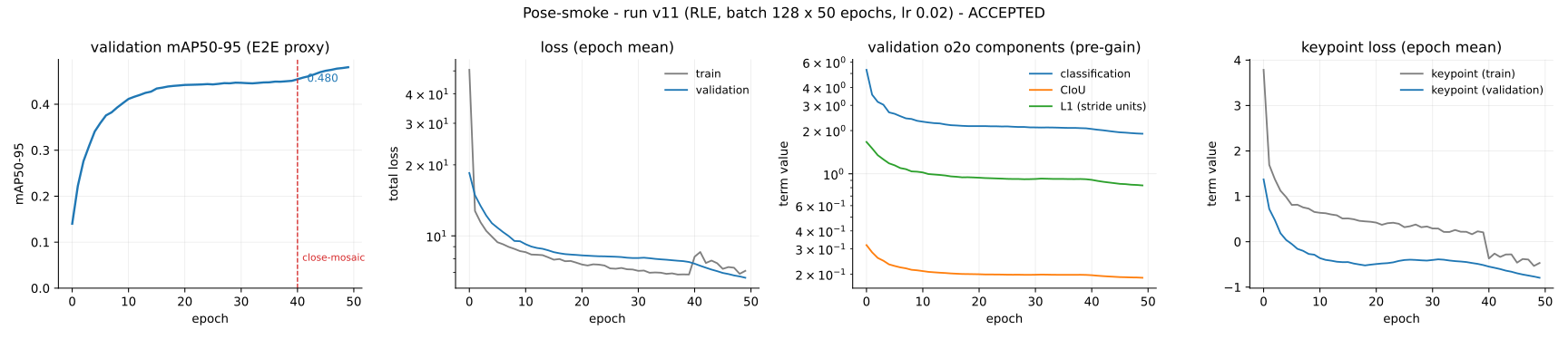
Run v11, four panels. The validation box mAP50-95 (the same E2E proxy the other three tiers log); epoch-mean loss totals; the one-to-one branch's pre-gain box/classification/L1 components; and the RLE keypoint term, train and validation.
The metric is still rising at epoch 49. val/mAP (box) has not plateaued the way Det-smoke's or Seg-smoke's had by this point in the schedule — its last epoch-to-epoch step is still positive. Fifty epochs may not be this run's ceiling the way it plausibly is for the oriented tier; no further epochs have been run to check.
Validation loss descends almost without exception. Two of forty-nine epoch-to-epoch steps rise, the larger by 0.30% — an order of magnitude cleaner than the oriented tier's own curve, and closer to Det-smoke's and Seg-smoke's monotone descent. The minimum sits at the final epoch, 49, unlike the oriented run's epoch 48.
The keypoint term crosses zero, and that is expected, not a fault. val/keypoint opens at 1.37 and closes at -0.79 — a negative log-likelihood, unlike every other logged term, is a normalized density's log and has no floor at zero the way a squared error or an IoU term does. A more negative value is a tighter fit, and this run's own trajectory is monotone toward it with the same two-rise exception the loss panel shows.
Acceptance
Not accepted on a pose figure. pose_nano_smoke.yaml names training completion and stability, and — the criterion actually decisive for this tier — RLE's mechanism claim against WP-135's Laplace-NLL control, read in full in ../work_packages/wp-125.md#wp-125.
| criterion | required | observed | |
|---|---|---|---|
| wiring gate | train OKS AP ≥ 0.30 | 0.3357 | ✓ |
| training completed | 50/50 epochs, all logged | 50 validation rows, no gaps | ✓ |
| no divergence | — | val/loss 18.47 → 6.65, minimum at epoch 49; 2 of 49 steps rise, the largest 0.30% |
✓ |
| RLE beats the Laplace-NLL control | direction of effect, not a magnitude | e2e OKS AP 0.2738 vs 0.2527 (version_14) — same sign as R14 Table 7's 70.5-vs-67.4 AP |
✓ |
keypoint_flip_pairs exercised live, tier scale |
not a mechanism failure | trained without incident, both arms (A64) | ✓ |
keypoint_gain = 1.0 exercised, tier scale |
not a mechanism failure | trained without incident, both arms; tuned adequacy unmeasured (A68) | ✓ |
| Phase ≤11 gates | green | full suite and 21/21 goldens at commit time | ✓ |
| pose figure itself | not the criterion — recorded, not cleared | 0.2738 e2e OKS AP, 0.5030 e2e box mAP | — |
Assumption outcomes
Assumptions the keypoint phase exercised. Full register in ASSUMPTIONS.md.
| id | subject | outcome |
|---|---|---|
| A64 | dataset-supplied flip pairing | held, first exercised live at tier scale here — resolved by WP-132's own reading of the training path; this run is the first to train with it through real augmentation rather than through the overfit gate's augmentation-off path |
| A65 | sigma via sigmoid | held — resolved by WP-123 directly from R14 sec. 3.3; unexercised further by this run beyond what WP-132's gate already confirmed |
| A66 | v=0 excluded, v≥1 included equally |
held, exercised at COCO scale — this run is the first to train the policy against real annotation visibility rather than synthetic fixtures |
| A67 | uniform sigma for non-COCO schemas | not exercised — this run's num_keypoints == 17 takes R12's own table, the branch A67 governs |
| A68 | keypoint_gain = 1.0, un-tuned |
the mechanism-failure exposure did not happen — a real pose head trained in both arms rather than one swamped by or swamping the detection objective; tuned adequacy stays unmeasured, no sweep ran |
| A69 | one shared RLE flow across both branches | untested against the alternative — this run trains one flow, as every run does; nothing here compares it to two |
| A70 | off-canvas points carried through unchanged | exercised, unmeasured — real augmentation ran, so some points left the canvas on kept instances; no measurement of how often or with what effect |
| A71 | per-axis residual frame | held — resolved by WP-132's numerical check; this run trained without the non-finite failure the un-normalized frame produced |
| A72 | RealNVP's tanh-bounded log-scale | held — resolved by WP-123/WP-132; no runaway observed across 46,250 steps |
| A73 | keypoints stays hand-driven, not forked onto torchmetrics | unaffected by this run — a WP-138 decision about the standalone evaluator, not the training path this run exercises |
Deviations from the paper, and from the earlier tiers
- Epoch budget. 50 epochs at n scale, one seed — a smoke tier by design, and R14's own schedule is a from-scratch top-down crop regressor, not a directly comparable budget to begin with.
- No Objects365 pretraining, no evolutionary hyperparameter search (D2).
- No comparison to any published pose figure. R14 reports on a top-down, cropped-input architecture; this project's dense one-stage detector with a bottom-up point stem is not the same architecture family, and no attempt is made here to set this run's OKS beside R14's own numbers or R1 Table 9's mAP=63.0 (a different paper's different architecture). The acceptance criterion is the mechanism's direction of effect, read from the paired run in
../work_packages/wp-125.md#wp-125, not an absolute figure. - The keypoint gain is this project's, not the paper's. R14 states the loss and never a multi-task weight — it trains a pose-only network.
keypoint_gain = 1.0(A68) is this project's own un-tuned starting point, the same shape of choice A22 made for the oriented tier's angle gain. - The parameter/FLOP gate has no published reference for this task family, unlike detection ([R1 Table 7]) and segmentation ([R1 Table S9]) — R14 states no architecture at all.
- Single flow, not measured against two per branch (A69) — untested here, as in every run so far.
Reproducing this result
lucid-data download --data_root /content/coco2017 --splits '[train,val]' --verify true
lucid-data check    --data_root /content/coco2017

lucid-yolo fit --config pose_nano_smoke.yaml \
  --data.data_root /content/coco2017 \
  --data.batch_size 128 --data.num_workers 32 --data.prefetch_factor 1 \
  --model.lr 0.02 --trainer.max_epochs 50 --trainer.precision bf16-mixed \
  --trainer.default_root_dir /content/drive/MyDrive/lucid_runs

lucid-eval --checkpoint <checkpoint> --data_root /content/coco2017 --output pose_report.json
The Laplace-NLL control arm is the same command against pose_nano_smoke_laplace_nll.yaml, byte-identical but for keypoint_loss.
Seed 0 throughout. Cross-platform bitwise reproduction is not claimed (A26). The metric reports are archived beside each run's own checkpoint, and the run config, hyperparameters and epoch metrics under lightning_logs/version_11/ (RLE) and lightning_logs/version_14/ (Laplace-NLL control).