Functions🔗
This page covers these deprecation patterns for Python functions and methods:
- Forward calls to a replacement.
- Rename arguments.
- Emit a notice with no replacement.
- Remap arguments within the same function.
- Stack multiple decorators.
- Suppress deprecations conditionally.
For class deprecation see Classes; for async functions see Async.
@deprecated vs. deprecated_callable
@deprecated is the friendly front door. Applied to a function, method, or other callable/descriptor, it behaves exactly as documented on this page.
Applied to a class, it dispatches to deprecated_class with a one-time informational notice rather than raising an error.
Use deprecated_callable() for a strict, callable-only form, for example to enforce "only functions here". It shares every parameter with @deprecated and raises TypeError immediately when applied to a class at decoration time.
Simple function forwarding🔗
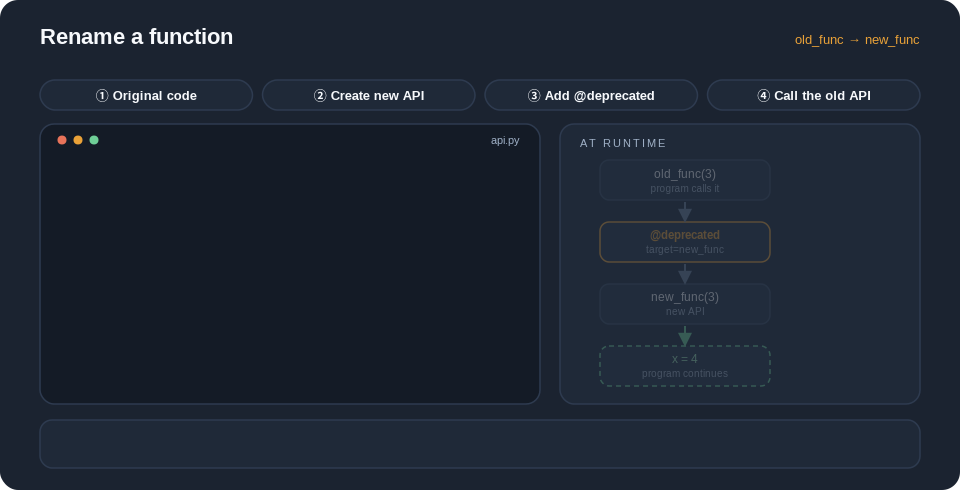
Body is dead code when target=<callable>
When target is a callable, pyDeprecate intercepts every call before the function body runs. The body is dead code under normal forwarding.
Exception: if you also use skip_if and it evaluates True at call time, the source body executes as a fallback. In that case keep a working body; otherwise skip_if=True calls silently return None.
Do not call the target from inside the body:
from deprecate import deprecated, void


def score_predictions(val: int) -> int:
    return val * 2


# WRONG — score_predictions(val) is never reached; the decorator forwards before the body runs
@deprecated(target=score_predictions, deprecated_in="1.0", remove_in="2.0")
def score(val: int) -> int:
    return score_predictions(val)


# CORRECT — body is empty; pyDeprecate handles all forwarding automatically
@deprecated(target=score_predictions, deprecated_in="1.0", remove_in="2.0")
def score(val: int) -> int:
    return void(val)  # or: pass  or: """Original function description."""
Apply @deprecated(target=<callable>) to the old name. pyDeprecate forwards every call, including positional and keyword arguments, to the new function.
Under normal forwarding the body is dead code, so leave it empty or put a docstring there. See also void() helper for a null-forwarding idiom.
Keep a fallback body with skip_if. The one exception is skip_if=True at call time, when the source body executes as a fallback. Keep a working body when combining target=<callable> with skip_if; see the danger admonition above.
The warning fires when the deprecated function is used:
| Function kind | Warning timing |
|---|---|
| Regular function | When the function is called. |
async def function |
When the coroutine is awaited. |
| Generator or async generator function | On the first next() / async for step; see Advanced and Async. |
Defining or importing the function does not warn. Importing a module that merely defines deprecated functions therefore stays silent.
Deprecated decorators warn at definition time. A deprecated function used as a decorator is the one exception. Applying it with @ calls it at the def statement, so it warns at definition time. See this troubleshooting answer and issue #96.
# NEW/FUTURE API — renamed to be more explicit about what it computes
def compute(a: int = 0, b: int = 3) -> int:
    """New function anywhere in the codebase or even other package."""
    return a + b


# ---------------------------

from deprecate import deprecated


# What this module looked like before the rename:
# def calculate(a: int, b: int = 5) -> int:
#     return a + b


# DEPRECATED API — `calculate` was the original name before the rename
@deprecated(target=compute, deprecated_in="0.1", remove_in="0.5")
def calculate(a: int, b: int = 5) -> int:
    """
    My deprecated function which now has an empty body
     as all calls are routed to the new function.
    """
    pass  # or you can just place docstring as one above


# calling this function will raise a deprecation warning:
#   The `calculate` was deprecated since v0.1 in favor of `your_module.compute`.
#   It will be removed in v0.5.
print(calculate(1, 2))
If the deprecated name already exists as a callable, apply deprecated() directly as a wrapper call instead of using decorator syntax. The callable might be imported from another package. This works on any callable, including ones you do not control.
from deprecate import deprecated


# NEW/FUTURE API — in real usage this would be imported from another module
def compute_sum(a: int, b: int = 0) -> int:
    return a + b


# LEGACY — already-existing callable that is being deprecated
def addition(a: int, b: int = 0) -> int:
    return a + b


# DEPRECATED API — `calculate` was the original name in this package;
# wrap it without redefining a function body
calculate = deprecated(
    target=compute_sum,
    deprecated_in="0.5",
    remove_in="1.0",
)(addition)
print(calculate(1, 2))
Partial and callable-instance targets🔗
target accepts any callable, including a named function, a class, a functools.partial that presets arguments, or an instance with __call__.
The warning names what a caller can import:
- For a partial, it names the wrapped function or class, using the innermost one for a nested partial.
- For a callable instance, it names the instance's class.
deprecated_class accepts a partial target too, for example partial(NewWidget, theme="dark"). @deprecated on a class forwards only a class target, so use deprecated_class(target=...) for a function or partial target.
A keyword the partial binds is the replacement's intended value, so the source's own default for that argument is not forwarded over it.
Per argument, values take precedence in this order:
- A value the caller passes, by keyword or by position, takes priority.
- The keyword the partial binds takes priority over the source default.
- The source default applies last.
from functools import partial

from deprecate import deprecated


# NEW API — general rounding helper; the precision is a parameter
def round_amount(amount: float, digits: int = 0) -> float:
    return round(amount, digits)


# DEPRECATED API — `round_price` always rounded to cents; it now forwards to `round_amount` with `digits=2` preset
@deprecated(target=partial(round_amount, digits=2), deprecated_in="0.5", remove_in="1.0")
def round_price(amount: float, digits: int = 4) -> float:
    pass


print(round_price(3.14159))  # warns: FutureWarning
print(round_price(3.14159, digits=3))
The first call gets the partial's digits=2, not the source default digits=4; the second call's explicit digits=3 wins over both. The warning names the function the partial wraps: The `round_price` was deprecated since v0.5 in favor of `your_module.round_amount`. ….
Positional arguments bound by a partial are not supported. pyDeprecate forwards arguments by name. A slot the partial binds positionally is no longer a parameter of the partial.
With partial(round_amount, 3.14159), the first call therefore raises TypeError: Failed mapping of `round_price`, arguments not accepted by target: ['amount']. Bind keywords only (partial(round_amount, digits=2)).
A functools.partial, partialmethod or singledispatchmethod cannot be the decorated source. None has a function body for the wrapper to take over, so @deprecated raises TypeError naming the type. Wrap the alias in a plain def that calls it and decorate that function instead.
Argument renaming and mapping🔗
Use args_mapping when the new function accepts the same arguments under different names. The decorator translates old parameter names to new ones at call time. Callers can keep passing the old names during the deprecation window without any manual mapping code.
import logging
from sklearn.metrics import accuracy_score
from deprecate import deprecated, void


@deprecated(
    # use standard sklearn accuracy implementation
    target=accuracy_score,
    # custom warning stream
    stream=logging.warning,
    # number of warnings per lifetime (with -1 for always)
    num_warns=5,
    # lifecycle metadata shown in notices and audit output
    deprecated_in="0.6",
    remove_in="1.0",
    # custom message template
    message_template="`%(source_name)s` was deprecated, use `%(target_path)s`",
    # as target args are different, define mapping from source to target func
    args_mapping={"preds": "y_pred", "target": "y_true", "blabla": None},
)
def depr_accuracy(preds: list, target: list, blabla: float) -> float:
    """My deprecated function which is mapping to sklearn accuracy."""
    # to stop complain your IDE about unused argument you can use void/empty function
    return void(preds, target, blabla)


# calling this function will raise a deprecation warning:
#   WARNING:root:`depr_accuracy` was deprecated, use `sklearn.metrics.accuracy_score`
print(depr_accuracy([1, 0, 1, 2], [0, 1, 1, 2], 1.23))
Passing both old and new argument names at once
If a caller supplies both the deprecated name and its replacement in one call, the explicit new-name value always wins. For example, this applies to fn(val=5, new_val=6). The remapped old-name value is silently discarded.
To make this visible, pyDeprecate also emits a UserWarning alongside the regular FutureWarning:
Clean up the call site by removing the deprecated argument name.
Notice-only deprecation🔗
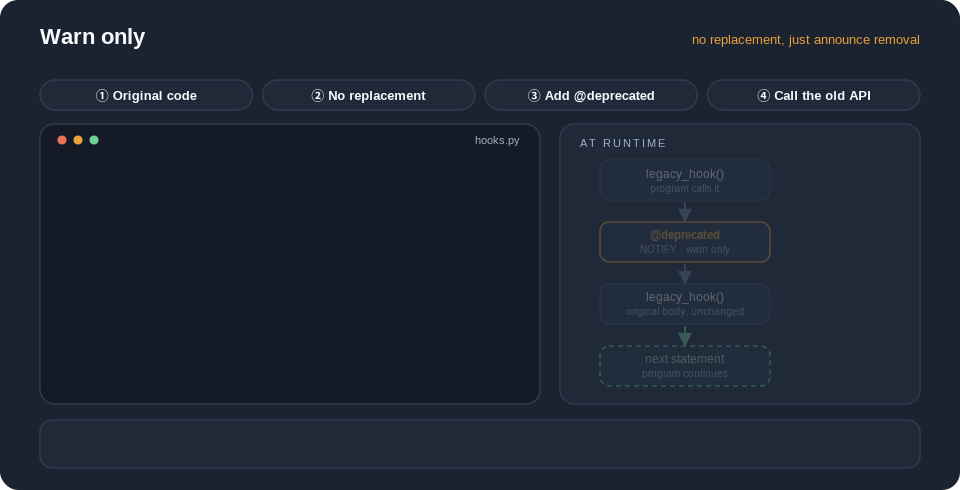
The function body still executes with TargetMode.NOTIFY — keep a working implementation
TargetMode.NOTIFY runs the original function body after emitting the deprecation notice. You must keep a working implementation in the function body. An empty body (pass) returns None instead of the intended value, although the deprecation warning still fires.
With target=<callable>, the body is dead code under normal forwarding. It still executes as a fallback when skip_if=True at call time.
Use warn-only mode when a function is going away but has no replacement yet. This is the right choice when callers need to update their own code, not switch to a different function.
The decorator emits a deprecation notice and then runs the function body normally. The source receives the caller's arguments unchanged. A functools.singledispatch function or a source with a custom __signature__ therefore dispatches exactly as it does undecorated.
An invalid call raises the same TypeError the undecorated function would, after the deprecation notice. Examples include a value passed both positionally and by keyword, or a positional-only parameter passed by keyword.
Prefer spelling out target=TargetMode.NOTIFY — it makes the warn-only intent explicit at the call site. If you omit target, the TargetMode.AUTO default resolves to TargetMode.NOTIFY when no args_mapping is given, so this shorter form is equivalent:
from deprecate import deprecated


@deprecated(deprecated_in="0.1", remove_in="0.5")
def my_sum(a: int, b: int = 5) -> int:
    """My deprecated function which still has to have implementation."""
    return a + b


# calling this function will raise a deprecation warning:
#   The `my_sum` was deprecated since v0.1. It will be removed in v0.5.
print(my_sum(1, 2))
Rename arguments within one function🔗
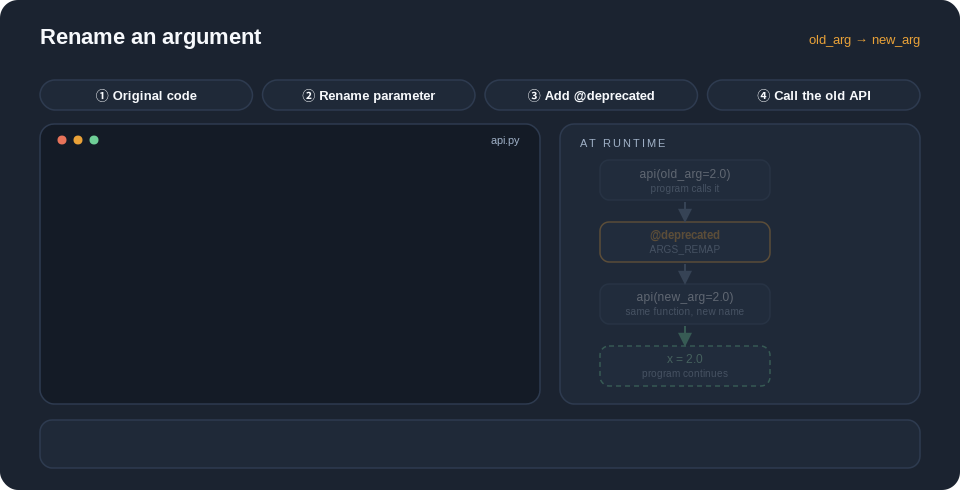
Use TargetMode.ARGS_REMAP to rename or drop an argument within the same function. The decorator remaps the old argument name before the body runs, so your implementation only needs the new name. This is the right pattern when refactoring a signature without moving the function.
Pass target=TargetMode.ARGS_REMAP explicitly alongside args_mapping for the recommended, self-documenting form.
On @deprecated, omitting target also works: a bare args_mapping auto-resolves via the TargetMode.AUTO default. The strict deprecated_callable() form always requires the explicit target.
from deprecate import TargetMode, deprecated


@deprecated(
    # rename an argument within the same function
    target=TargetMode.ARGS_REMAP,
    args_mapping={"coef": "new_coef"},
    # common version info
    deprecated_in="0.2",
    remove_in="0.4",
)
def any_pow(base: float, coef: float = 0, new_coef: float = 0) -> float:
    """My function with deprecated argument `coef` mapped to `new_coef`."""
    return base**new_coef


# calling this function will raise a deprecation warning:
#   The `any_pow` uses deprecated arguments: `coef` -> `new_coef`.
#   They were deprecated since v0.2 and will be removed in v0.4.
print(any_pow(2, 3))
To drop an argument entirely, map it to None. The decorator emits a deprecation notice when the argument is passed and then discards it.
from deprecate import TargetMode, deprecated
from typing import Optional


@deprecated(
    target=TargetMode.ARGS_REMAP,
    args_mapping={"num_workers": None},
    deprecated_in="1.8",
    remove_in="1.9",
)
def my_func(value: int, num_workers: Optional[int] = None) -> int:
    """num_workers is no longer used; omit it (auto-detected)."""
    return value * 2


# Passing the removed argument triggers a warning and the argument is silently discarded:
#   The `my_func` uses deprecated arguments: `num_workers` -> `None`.
#   They were deprecated since v1.8 and will be removed in v1.9.
print(my_func(value=42, num_workers=4))
Only None drops an argument. A mapped value of "" (empty string) keeps the argument under its old name. It is passed through to the function unchanged, and the deprecation notice still fires.
Changed in v0.15
deprecated_class proxies have always behaved this way; @deprecated now matches them. This changed in v0.15; before it, @deprecated dropped an argument mapped to "" just like one mapped to None. If you relied on that, map the argument to None instead.
TargetMode.NOTIFY vs TargetMode.ARGS_REMAP vs target=<callable> — key differences🔗
These modes differ in whether the function body runs, whether a warning fires, and which parameters take effect.
Mode defaults
TargetMode.NOTIFY replaces the old target=None sentinel and TargetMode.ARGS_REMAP replaces the old target=True sentinel. The old forms still work but emit a FutureWarning at decoration time.
On @deprecated, target defaults to TargetMode.AUTO. This fallback resolves an omitted target at decoration time:
| Mapping | Resolved mode |
|---|---|
Non-empty args_mapping |
ARGS_REMAP |
No mapping, including an empty {} |
NOTIFY |
The resolved mode, never AUTO itself, is stored in DeprecationConfig. Prefer passing the explicit mode so intent is visible at the call site.
The front door accepts target=TargetMode.AUTO written out. It is identical to omitting target and conveys nothing extra. The strict deprecated_callable(), whose default is TargetMode.NOTIFY, raises TypeError if you try.
Behaviour comparison🔗
TargetMode.NOTIFY |
TargetMode.ARGS_REMAP (with args_mapping) |
target=<callable> |
|
|---|---|---|---|
| Warning emitted | Yes — up to num_warns times (default: once) |
Per deprecated arg, up to num_warns times (default: once) |
Yes — up to num_warns times (default: once) |
| Warning template | "… was deprecated since vX. It will be removed in vY." |
"… uses deprecated arguments: …" |
"… was deprecated … in favour of …" |
message_template specifiers |
source_name, source_path, deprecated_in, remove_in only — target_name/target_path unavailable |
source_name, source_path, argument_map, deprecated_in, remove_in |
All specifiers incl. target_name, target_path |
| Function body | Runs with the caller's arguments unchanged | Runs after argument renaming/dropping | Does not run under normal forwarding — body is dead code, calls intercepted first. Exception: skip_if=True at call time bypasses forwarding and executes the source body as fallback |
args_mapping applied |
⚠ |
✓ renames or drops listed args |
✓ renames or drops args before forwarding |
args_extra injected |
⚠ |
✓ merged into kwargs before call |
✓ merged into kwargs before forwarding |
| Source defaults merged | ✗ |
✗ |
✓ |
skip_if effect |
⊛ |
⊛ |
⊛ |
stream=None effect |
⊘ body still runs |
⊘ remapping still runs |
⊘ forwarding still runs |
Legend:
| Symbol | Meaning |
|---|---|
✓ |
The option is applied. |
✗ |
The option is not applied. |
⚠ |
The option is ignored with UserWarning; this will be TypeError in v1.0. |
⊘ |
The warning is suppressed, but processing continues. |
⊛ |
skip_if bypasses everything. |
— |
The option is not applicable. |
When to use which🔗
| Mode | When to use it | Behaviour |
|---|---|---|
TargetMode.NOTIFY |
The function is going away with no replacement; callers must remove the call. | The warning fires up to num_warns times per wrapper (default: once); the first call exhausts the default budget. |
target=<callable> |
The function is replaced by another callable. Use args_mapping to rename arguments and args_extra to inject new required args. |
The source body never runs under normal forwarding. The exception is skip_if=True, which bypasses forwarding and executes the source body as fallback. |
TargetMode.ARGS_REMAP + args_mapping |
The function stays but its signature is changing. | The warning fires only when the old argument name is actually used. Callers who already migrated see no noise. |
Example — notice the difference in warning behaviour🔗
from deprecate import TargetMode, deprecated


# TargetMode.NOTIFY: warns once by default (num_warns=1)
@deprecated(target=TargetMode.NOTIFY, deprecated_in="1.0", remove_in="2.0")
def going_away(val: int) -> int:
    return val


# TargetMode.ARGS_REMAP: warns only when the old argument name is passed
@deprecated(target=TargetMode.ARGS_REMAP, args_mapping={"val": "new_val"}, deprecated_in="1.0", remove_in="2.0")
def renamed_arg(val: int = 0, new_val: int = 0) -> int:
    return new_val


going_away(1)  # warns: FutureWarning — "going_away was deprecated since v1.0 …"
renamed_arg(new_val=1)  # silent — new name used, no deprecated arg present
renamed_arg(val=1)  # warns: FutureWarning — "renamed_arg uses deprecated arguments: `val` → `new_val` …"
target=True (or TargetMode.ARGS_REMAP) without args_mapping is a misconfiguration. Since v0.8, target=True is a deprecated sentinel for TargetMode.ARGS_REMAP. Using either without args_mapping emits construction-time warnings:
- The legacy sentinel emits a
FutureWarning. ARGS_REMAPemits aUserWarningbecause it requiresargs_mappingto have any effect.
This will become a TypeError in v1.0. If your intent is to warn callers with no forwarding or remapping, use TargetMode.NOTIFY instead.
Stacked deprecation decorators🔗
Stack multiple @deprecated decorators on a single function to handle migrations that span several releases. Each layer tracks its own version range and warning count independently.
Not all stacking combinations are supported. Only three combinations work correctly. Everything else emits UserWarning at decoration time (not at call time) so you catch the misconfiguration immediately. See the supported combinations table below.
Pattern 1 — multi-step argument renames (ARGS_REMAP + ARGS_REMAP)🔗
When an argument is renamed more than once across releases, stack one @deprecated(TargetMode.ARGS_REMAP, ...) per rename. Each decorator operates on its own version range and emits a separate notice, giving callers version-specific migration guidance.
from deprecate import TargetMode, deprecated


@deprecated(
    TargetMode.ARGS_REMAP,
    deprecated_in="0.3",
    remove_in="0.6",
    args_mapping=dict(c1="nc1"),
    message_template="Depr: v%(deprecated_in)s rm v%(remove_in)s for args: %(argument_map)s.",
)
@deprecated(
    TargetMode.ARGS_REMAP,
    deprecated_in="0.4",
    remove_in="0.7",
    args_mapping=dict(nc1="nc2"),
    message_template="Depr: v%(deprecated_in)s rm v%(remove_in)s for args: %(argument_map)s.",
)
def any_pow(base, c1: float = 0, nc1: float = 0, nc2: float = 2) -> float:
    return base**nc2


# calling this function will raise deprecation warnings:
#   FutureWarning('Depr: v0.3 rm v0.6 for args: `c1` -> `nc1`.')
#   FutureWarning('Depr: v0.4 rm v0.7 for args: `nc1` -> `nc2`.')
print(any_pow(2, 3))
Pattern 2 — lifecycle migration (ARGS_REMAP + NOTIFY)🔗
The most common real-world lifecycle has two stages:
- An argument is renamed in an early release (
ARGS_REMAP). - The entire function is deprecated in a later release once a complete replacement exists (
NOTIFY).
Put ARGS_REMAP outermost (top decorator) and NOTIFY below it.
Callers still using the old argument name receive both warnings — the arg-rename notice and the function-deprecated notice. Callers already using the new name receive only the function-deprecated notice.
from deprecate import TargetMode, deprecated


@deprecated(TargetMode.ARGS_REMAP, deprecated_in="1.0", remove_in="2.0", args_mapping={"factor": "scale"})
@deprecated(TargetMode.NOTIFY, deprecated_in="2.0", remove_in="3.0")
def compute_power(base: float, factor: float = 1, scale: float = 1) -> float:
    return base**scale


print(compute_power(2, factor=3))  # → 2 warnings (arg rename + function deprecated)
print(compute_power(2, scale=3))  # → 1 warning  (function deprecated only)
Wrong order raises UserWarning at decoration time. @deprecated(NOTIFY) on top of @deprecated(ARGS_REMAP) is the wrong order — pyDeprecate detects it and warns immediately at decoration time with the message "Reverse the decorator order: put @deprecated(ARGS_REMAP, ...) outermost".
Supported stacking combinations🔗
| Outer (top) | Inner (bottom) | Status | Notes |
|---|---|---|---|
ARGS_REMAP |
ARGS_REMAP |
✅ | Multi-step argument renames across versions |
ARGS_REMAP |
NOTIFY |
✅ | Lifecycle: rename args first, then deprecate the whole function |
NOTIFY |
callable |
✅ | Outer NOTIFY warns callers the function is going away; inner callable handles forwarding. Prefer @deprecated(target=<callable>) directly — same effect, simpler. |
callable |
callable |
❌ | Use a single @deprecated(target=<callable>) instead |
callable |
ARGS_REMAP |
❌ | Collapse to @deprecated(target=fn, args_mapping={...}) |
callable |
NOTIFY |
❌ | Collapse to a single @deprecated(target=<callable>) |
ARGS_REMAP |
callable |
❌ | Update the inner decorator to include both target= and args_mapping= |
NOTIFY |
NOTIFY |
❌ | Update the existing decorator's versions instead of adding a second one |
NOTIFY |
ARGS_REMAP |
❌ | Wrong order — swap: ARGS_REMAP on top, NOTIFY below |
✅ = supported
❌ = unsupported — emits UserWarning at decoration time
N-level stacking🔗
Any sequence of supported adjacent pairs stacks transitively. The guard inspects only one hop at a time — as long as each adjacent pair is a supported combination, the full stack is accepted silently.
Example — three-level lifecycle migration:
from deprecate import TargetMode, deprecated


@deprecated(TargetMode.ARGS_REMAP, deprecated_in="0.3", remove_in="0.6", args_mapping={"c1": "nc1"})
@deprecated(TargetMode.ARGS_REMAP, deprecated_in="0.4", remove_in="0.7", args_mapping={"nc1": "nc2"})
@deprecated(TargetMode.NOTIFY, deprecated_in="0.7", remove_in="1.0")
def any_pow(base, c1: float = 0, nc1: float = 0, nc2: float = 2) -> float:
    return base**nc2


print(any_pow(2))
Each adjacent pair is ARGS_REMAP + ARGS_REMAP (supported) and ARGS_REMAP + NOTIFY (supported), so no decoration-time warning fires. The three layers execute in turn at call time.
Unsupported pair breaks the whole chain. A single unsupported adjacent pair anywhere in the stack emits UserWarning at decoration time for that pair. Chains with NOTIFY + ARGS_REMAP adjacent remain unsupported — the wrong-order warning still fires.
Use validate_deprecation_chains() in CI to catch accidental deprecated-to-deprecated chains automatically.
Conditional skip🔗
skip_if accepts a boolean or a zero-argument callable returning a boolean. When it evaluates to True, the deprecation notice is suppressed and the call proceeds normally.
This is useful when behaviour depends on runtime conditions, for example suppressing the notice once the caller has migrated to a newer dependency. skip_if is available on @deprecated, deprecated_callable(), and the class/instance proxies; see Classes.
from deprecate import TargetMode, deprecated_callable

FAKE_VERSION = 1


def version_greater_1():
    return FAKE_VERSION > 1


@deprecated_callable(TargetMode.ARGS_REMAP, "0.3", "0.6", args_mapping=dict(c1="nc1"), skip_if=version_greater_1)
def skip_pow(base, c1: float = 1, nc1: float = 1) -> float:
    return base ** (c1 - nc1)


# calling this function will raise a deprecation warning
print(skip_pow(2, 3))

# change the fake versions
FAKE_VERSION = 2

# will not raise any warning
print(skip_pow(2, 3))
Fatal deprecations🔗
as_exception=True raises DeprecatedError instead of emitting the warning, carrying the same rendered message. The call is refused: the forwarding target is never invoked and the source body never runs. TargetMode.NOTIFY and TargetMode.ARGS_REMAP therefore stop instead of falling through to the body.
This is the middle step of the warn → raise → delete lifecycle. It is available on every entry point: @deprecated, deprecated_callable(), deprecated_class(), deprecated_instance(), and deprecated_module().
num_warns does not apply in fatal mode. A fatal deprecation raises on every call. A budget would stop refusing after the first attempt, allowing a caller retrying inside except to sail through.
stream=None silences the message, not the raise. Fatal mode is a lifecycle state, not an output channel.
skip_if still suppresses everything, fatal deprecations included — a wrapper switched off by configuration is not a deprecation at that moment.
from deprecate import DeprecatedError, TargetMode, deprecated_callable


@deprecated_callable(TargetMode.NOTIFY, "1.0", "2.0", as_exception=True)
def legacy_checksum(payload: str) -> int:
    return len(payload)


try:
    legacy_checksum("abc")
except DeprecatedError as err:
    print(err)

# the call is refused again: the `num_warns` budget does not apply to a fatal deprecation
try:
    legacy_checksum("again")
except DeprecatedError as err:
    print(type(err).__name__)
Output: legacy_checksum("abc"); legacy_checksum("again")
The global switch🔗
deprecate.AS_EXCEPTIONS is the process-wide default, seeded at import from the DEPRECATE_AS_EXCEPTIONS environment variable. Values 1, true, yes, or on enable it; anything else is off.
It is re-read on every emission. An application can flip it during bootstrap and a test suite can toggle it per case:
To make deprecations fatal for one stretch of code only, use the as_exceptions() context manager. Deprecations that defer to the global switch raise inside the block. The previous setting applies again on exit, including when the block raises, so nested scopes compose.
as_exceptions(False) does the reverse and exempts a block from a strict run. It also works as a decorator.
from deprecate import DeprecatedError, as_exceptions, deprecated


# NEW API — replacement that calculates the total
def calculate_total(a: int, b: int) -> int:
    return a + b


# DEPRECATED API — `legacy_total` now forwards to `calculate_total`
@deprecated(
    target=calculate_total,
    deprecated_in="1.0",
    remove_in="2.0",
    message_template="Use `calculate_total` instead.",
    num_warns=-1,
)
def legacy_total(a: int, b: int) -> int:
    pass


try:
    with as_exceptions():
        legacy_total(1, 2)
except DeprecatedError as err:
    print(err)

with as_exceptions(False):  # exempt this call, so the output holds even under DEPRECATE_AS_EXCEPTIONS=1
    print(legacy_total(1, 2))  # warns: FutureWarning
Output: legacy_total(1, 2) in the strict block, then in the exempt block
The scope is held in a ContextVar, local to the current thread and asyncio task. Other threads and sibling tasks keep the global setting, and holding a scope across an await is safe.
Tasks created inside the block inherit the scope, because a task copies the context when it is created. Whether a new thread inherits it depends on the interpreter:
- A new thread inherits the scope only when the interpreter copies the starting context into it. That is
sys.flags.thread_inherit_contexton Python 3.14+: on by default in free-threaded builds, opt-in with-X thread_inherit_context=1otherwise. - An inheriting thread, including a pool worker started inside the scope, keeps the scope after the block closes.
- Otherwise,
asyncio.to_threadcarries the scope into a thread by default. - Any other thread inherits it only through explicit propagation:
contextvars.copy_context().run(...), orthreading.Thread(context=...)on Python 3.14+. loop.run_in_executordoes not propagate context per call. A worker started outside the scope sees the global setting; an inheriting worker started inside it retains that scope.
Run the thread's target through contextvars.copy_context().run(...) when it must inherit the scope.
The scope never modifies deprecate.AS_EXCEPTIONS. Inside the block that attribute still reports the global value, and assigning it there takes effect once the block closes.
Scope and decorator limits
A generator or async generator shares its consumer's context. A scope held across a yield also applies to the consumer while the generator is suspended. Open and close the scope within one step of the generator; see Limitations.
As a decorator it only covers plain synchronous functions. Decorating an async def, generator or async-generator function raises TypeError, because its body would run after the scope closed. Use with as_exceptions(): inside the body instead.
A non-bool flag, including a bare @as_exceptions without parentheses, raises TypeError at the call.
Like deprecate.AS_EXCEPTIONS itself, it is the consumer's switch: an application or test suite. Library code should not use as_exceptions(False) to escape a caller's strict run.
Precedence is monotonic: an explicit as_exception=True is always fatal. as_exception=False means "not fatal by default" but still yields to a True global.
A wrapper's own as_exception=False therefore cannot opt a consumer's strict run out. Only the consumer's own as_exceptions(False) scope or AS_EXCEPTIONS setting can do that. An author can still promote one symbol ahead of the rest.
Recipe: the warning becomes an error at version X🔗
To promote a deprecation from warning to error on a schedule, compute as_exception from your package version and a version of your choosing. Here that version is ERROR_IN, typically between deprecated_in and remove_in. as_exception is read once, at decoration time, so the switch flips on the first import under the new version.
Compare parsed versions rather than strings. Tuples below keep the example dependency-free; packaging.version.Version works the same.
from deprecate import DeprecatedError, TargetMode, deprecated_callable

PACKAGE_VERSION = (1, 3)  # in a real package: parse your own `__version__`
ERROR_IN = (1, 3)  # the release where callers must stop using the old name


@deprecated_callable(TargetMode.NOTIFY, "1.0", "2.0", as_exception=PACKAGE_VERSION >= ERROR_IN)
def legacy_digest(payload: str) -> int:
    return len(payload)


try:
    legacy_digest("abc")
except DeprecatedError as err:
    print(err)
Output: legacy_digest("abc")
Below ERROR_IN the same code only warns. As the release-time backstop, run pydeprecate expiry in CI. It exits 1 when any wrapper is past its remove_in deadline, so a deprecation that was never deleted cannot ship by accident.
When to prefer -W error instead🔗
Python already turns warnings into exceptions: -W error::FutureWarning or PYTHONWARNINGS=error::FutureWarning. Use those when you want every library's FutureWarning to raise. as_exception exists for the three cases they cannot cover:
- Scope — fail only on pyDeprecate's own deprecations, not on NumPy's or pandas'.
- Non-warnings streams — a wrapper with
stream=logging.warningnever reaches the warnings machinery, so no filter can make it fail. - Per-symbol promotion — ship one deprecation as fatal while the rest keep warning.
Strict callable-only deprecation🔗
@deprecated dispatches a class source to @deprecated_class(). @deprecated_callable() is the strict form: it shares every @deprecated parameter but raises TypeError at decoration time when applied to a class. A mistaken class decoration then fails on import instead of silently becoming a proxy.
Use it where the class path should never be taken implicitly:
- shared library code;
- internal helpers that only wrap functions;
- modules whose reviewers want the class case to be an error.
from deprecate import deprecated_callable


# NEW API — renamed to say what it measures
def elapsed_seconds(start: float, end: float) -> float:
    return end - start


# DEPRECATED API — `duration` was the original name before the rename
@deprecated_callable(target=elapsed_seconds, deprecated_in="1.4", remove_in="2.0")
def duration(start: float, end: float) -> float: ...


print(duration(10.0, 12.5))  # warns: FutureWarning
Applied to a class, it refuses at decoration time:
from deprecate import deprecated_callable


class HttpClient:
    """The replacement class."""


try:

    @deprecated_callable(target=HttpClient, deprecated_in="1.4", remove_in="2.0")
    class Client:
        """A class handed to the strict callable-only decorator."""

except TypeError as err:
    print(type(err).__name__)
The error names both alternatives: @deprecated_class() for the class itself, or @deprecated for automatic dispatch.
Different target defaults. @deprecated defaults target to TargetMode.AUTO, inferred at decoration time. deprecated_callable() defaults to TargetMode.NOTIFY and rejects an explicit TargetMode.AUTO with TypeError.
Static type checkers (PEP 702)🔗
mypy, pyright, and IDEs flag a deprecated symbol only when its decorator is literally warnings.deprecated (Python 3.13+) or its backport typing_extensions.deprecated. They recognise the decorator by name, not by what it does at runtime. @deprecated from pyDeprecate is invisible to them.
To get the strikethrough in the editor and pyDeprecate's forwarding and warning, stack the PEP 702 decorator directly above pyDeprecate's:
import typing_extensions  # on Python 3.13+: `import warnings` and `@warnings.deprecated(...)`

from deprecate import deprecated


# NEW API — the renamed helper
def fetch_orders(customer_id: int) -> list:
    return [customer_id]


# DEPRECATED API — struck through by type checkers, forwarded with a warning at runtime
@typing_extensions.deprecated("Use `fetch_orders` instead.", category=None)
@deprecated(target=fetch_orders, deprecated_in="1.4", remove_in="2.0")
def get_orders(customer_id: int) -> list: ...


print(get_orders(7))  # warns: FutureWarning
Four rules make the pair work:
| Rule | Reason or placement |
|---|---|
Set category=None. |
The PEP 702 decorator then only marks the symbol for type checkers. Otherwise every call emits a second DeprecationWarning next to pyDeprecate's FutureWarning. |
| Use a string-literal message. | mypy silently ignores a message held in a constant or built with an f-string. pyright still flags the symbol but drops the text. |
Place it directly above @deprecated(...). |
Keep it inside @staticmethod / @classmethod, and above the outer-order @deprecated(...) @property. mypy asks for # type: ignore[prop-decorator] on that line, as it does for any decorator above @property. Placed under @property, pyright misses it. |
| Import the module, not the name. | from typing_extensions import deprecated shadows pyDeprecate's deprecated. Write @typing_extensions.deprecated(...) or @warnings.deprecated(...). |
IDEs strike the symbol through as soon as the decorator is there. To fail CI on new uses, turn the diagnostic into an error — mypy leaves it off by default:
Since v0.14, @deprecated and deprecated_callable() keep the decorated callable's own type, and the package ships a py.typed marker. Type checkers therefore see the real signature and name the symbol correctly in the diagnostic.
For class aliases see Classes → Type annotations and static analysis. To list symbols deprecated with the PEP 702 decorator alone, see include_pep702.
Static types vs runtime
That static type is the source's type. Decorating a functools.lru_cache / functools.cache object returns a plain function. cache_clear() and cache_info() are gone even though type checkers still offer them.
Deprecate the underlying function and put the cache on top (@functools.lru_cache above @deprecated(...)). The cache attributes then exist, but a cache hit never reaches the wrapper. The warning therefore fires only on a miss.
A functools.partial is rejected at decoration time; wrap it in a plain def and decorate that. Other callable objects without a __name__ are rejected too; wrap those with deprecated_instance().
See also🔗
| Page | Topic |
|---|---|
| Use Cases overview | Start here for a guided tour of all deprecation patterns. |
| Classes | Learn about class, Enum, dataclass, and instance deprecation. |
| Properties | Deprecate @property and @cached_property. |
| Async | Deprecate async functions and async generators. |
| Advanced | Explore docstring updates, args_extra, testing helpers, class/static methods, and generators. |
| Customization | Customize message templates and output streams. |
| void() Helper | Learn when and why to use void() in the function body. |
| Audit Tools | Enforce removal deadlines and detect deprecation chains in CI. |
| Troubleshooting | Find common errors and fixes. |
Next: Classes — deprecating classes, Enums, and dataclasses.